
R&D and engineering · Clean energy
REVFRACC
Cryogenic direct air capture, from lab rig to pilot plant.
Reverse Fractionating Atmospheric Carbon Capture, Atmosfuture's chemical-free DAC system. Designed, built and lab-tested by Enigmasoft in Goa.
- Client
- Atmosfuture (UK)
- Service name
- Direct Air Capture · Cryogenic Air Separation
- Systems
- VECC heat exchangers · INIJEVID expanders
- Our role
- Design, build, test and industrialisation partner, Goa
Overview
Freezing CO₂ out of ambient air, no sorbents, no solvents.
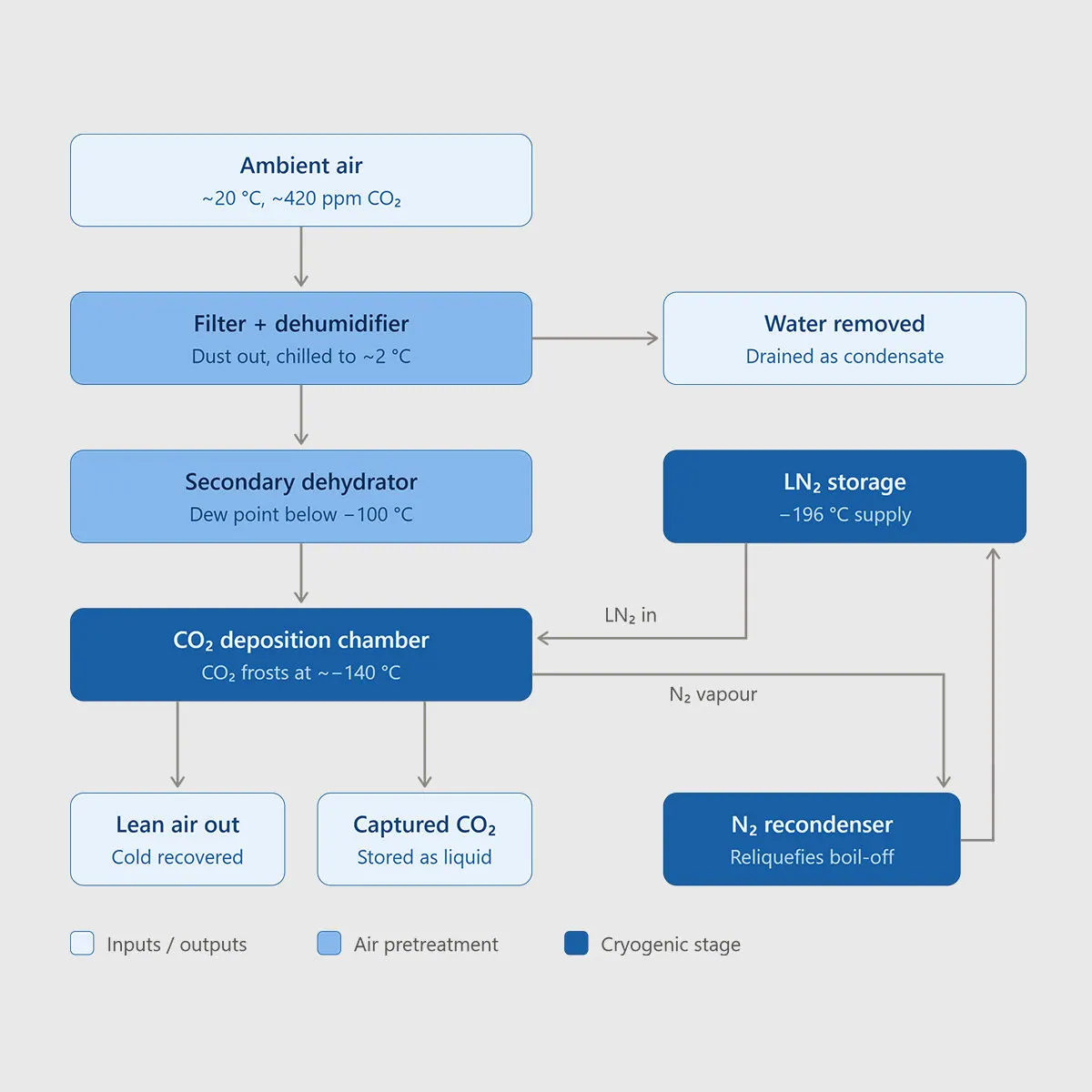
REVFRACC is Atmosfuture's cryogenic direct air capture and air-separation system. Instead of chemical sorbents, it cools ambient air in stages: water is removed first, then CO₂ is frozen out of the air stream at around −150 °C.
As Atmosfuture's engineering partner, Enigmasoft took REVFRACC from concept to working hardware. Our team in Goa designed, built, instrumented and tested the proof-of-concept rig, and is now engineering the pilot plant for manufacture.
Key results
- −151 °C
air temperature reached in the CO₂ deposition chamber
Lab, proof-of-concept rig
- 3 runs
instrumented proof-of-concept tests at 2, 5 and 7 bar
Lab, September 2026
The challenge
CO₂ is 0.04% of air, and moisture freezes long before it does.
- 0.04% CO₂ in ambient air
- Moisture freezes and blocks the line
- Sensors drift at cryogenic temperatures
- No chemicals, so no heat-regeneration route
Most direct air capture systems depend on chemical sorbents or solvents that must be regenerated with heat. A cryogenic route avoids those chemicals, but it has never been easy to engineer: moisture blocks equipment before CO₂ condenses, and standard valves, flow meters and sensors become unreliable at cryogenic temperatures.
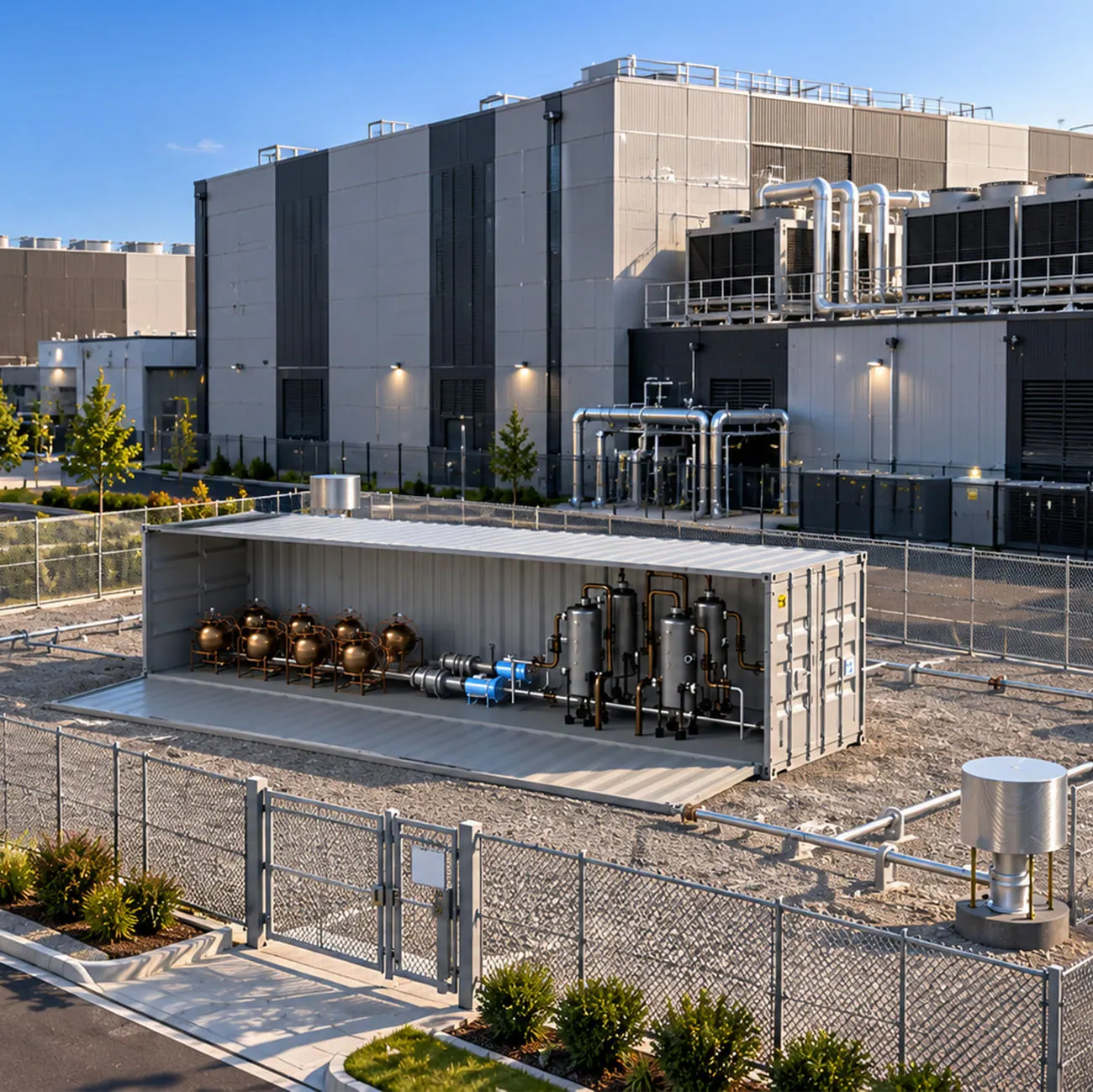
Atmosfuture needed an engineering partner to turn a process concept into measurable hardware: build a working rig, prove staged cooling and CO₂ deposition with real data, then scale the design into a manufacturable, transportable pilot plant.
Our solution
From process design to a pilot plant ready for manufacture.
Process & mechanical design
- Staged cooling process: filtration and dehumidification, secondary dehydration, then CO₂ deposition
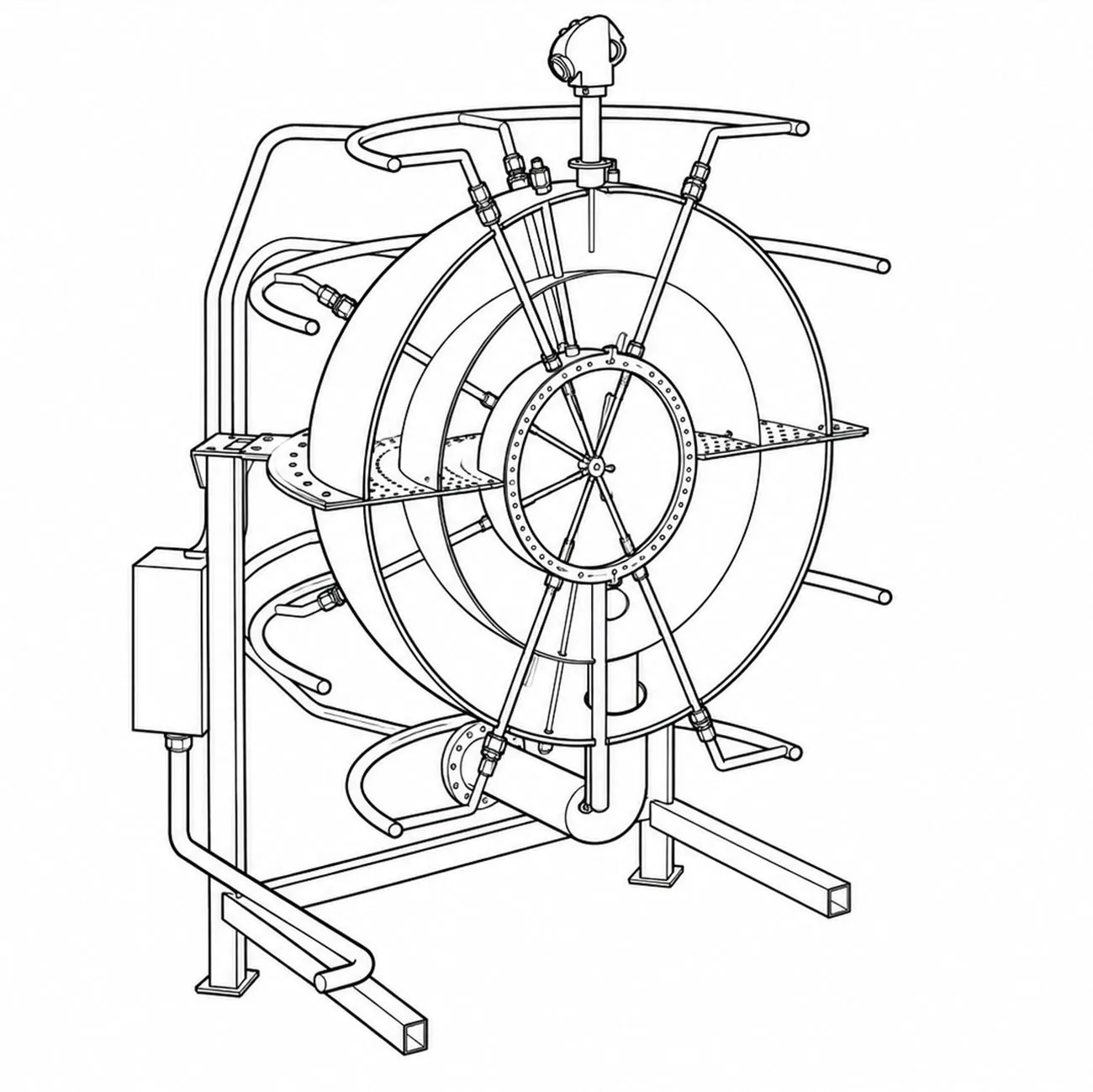
- 3D models and manufacturing drawings for the 430 mm VECC cryogenic heat-exchange module
- Completed screw designs for the INIJEVID cryogenic gas-expander
- Process flow diagram, P&ID set and design basis for the pilot plant
- Nitrogen circuit redesigned from open loop to closed loop (August 2026 design decision)
Proof-of-concept build & instrumentation
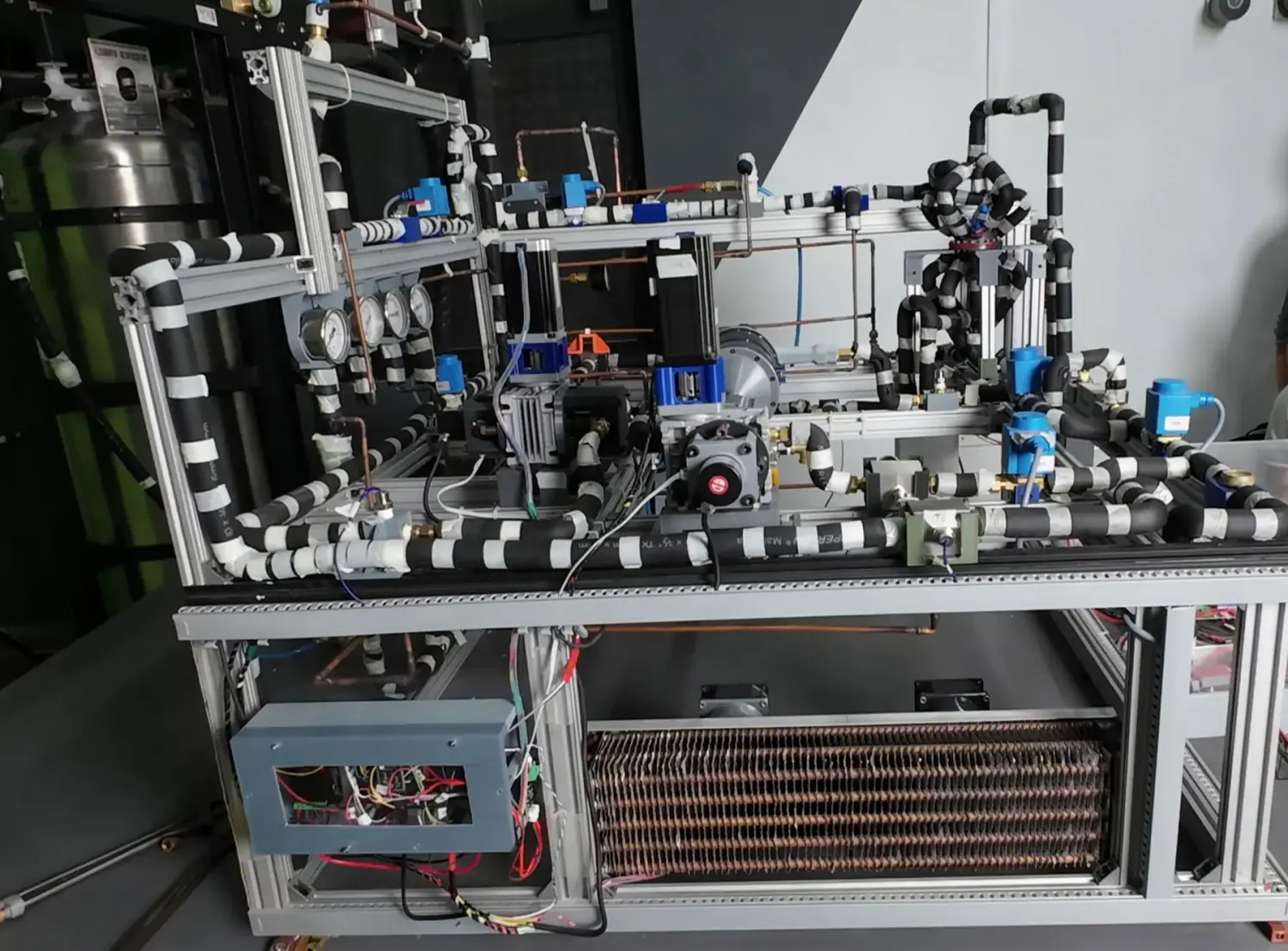
- Built the rig in Goa: filter/dehumidifier, secondary dehydrator, CO₂ deposition chamber (approx. 0.38 m² cold surface) and expander stage
- Liquid-nitrogen cooling and priming circuit with pressure-regulated supply
- PT100 temperature sensors, pressure sensors, air and nitrogen flow meters, CO₂ concentration sensing
- 3D-printed prototype expanders, sensor mounts and alternative nozzle inlets for rapid iteration
Testing & validation
- Three instrumented proof-of-concept runs at 2, 5 and 7 bar nitrogen supply pressure (September 2026)
- Repeatable compressed-air test campaigns on expander prototypes, with three runs per configuration
- Sensor setup and calibration checks before each campaign; full test reports issued to the client
- Lessons fed straight into the pilot design: full-bore actuated ball valves to cut pressure drop, Coriolis flow metering for cryogenic service, higher-range CO₂ sensing
Inside the build
What our team designed, built and tested
Technology and tools
The engineering stack behind the rig.
- Cryogenics (liquid nitrogen, liquid air)
- Staged cryogenic dehydration
- CO₂ deposition (desublimation)
- Cryogenic heat-exchanger design
- Gas-expander design
- Torque cradle & tachometer test rigs
- 3D CAD & manufacturing drawings
- CFD modelling
- PFD / P&ID
- PLC / HMI controls
- Additive manufacturing for prototypes
- PT100 sensors & pressure transducers
- Vortex & Coriolis flow metering
- CO₂ concentration sensing
Aim and current status
What our own team in Goa designed, built and tested.
Enigmasoft's engineering team delivered the hands-on work behind REVFRACC.
- Design — 3D models, manufacturing drawings, sensor lists and sub-system definitions for the VECC heat exchangers, INIJEVID expanders and supporting systems
- Build — fabricated, assembled and instrumented the proof-of-concept rig, including 3D-printed prototype expanders and sensor mounts
- Test — planned and ran the proof-of-concept campaigns, with full reports issued to the client
Have a problem like this one?
Start with a fixed-scope discovery sprint. You own the technical plan outright, whether or not we build the next stage together.